
The Regenerative and Yearning Octopus
Thoughts on careers, life directions and Tim Urban's tour de force on understanding yourself

I first read Tim Urban's Wait But Why post on How to Pick a Career (That Actually Fits You) about four years ago. Well, I say I read it; I think I actually read half of it, got overwhelmed and skimmed the rest; then came back to it a few months later, read a bit more; meant to finish it, didn't quite get round to it, forgot about it, came back to it the next year, and so on. From talking to others, this isn't a particularly unusual way to relate to some of Tim's posts, but this one in particular is something of a magnum opus and, with the density of insight and instruction in it, has gained a dedicated following for good reason. It's always stuck in my mind as one of the best career reflection tools out there, and having come back to it in the last few weeks, I thought I would try to capture some of my thoughts as I’ve gone through his process myself.
There are some very lucky people out there who know what they want to do from a young age, decide on a career path, pursue the right courses and opportunities, and slot relatively comfortably into that field. Until the point that we are spat out of the higher education pond (as Tim puts it) we follow a very structured, pre-determined educational route. Given that, it suits a lot of people quite well that generally speaking, the world of work is structured so that (despite a frankly boggling range of options) you can still continue into a series of structured, pre-determined routes. This kind of direction and specialism overall serves much of society very well - a level of predictability and structure serves a lot of types of people psychologically, but it also serves our collective need for expertise and skill, since it allows for rapid specialisation and fast learning. Unfortunately, that's never been me, and so I finished university as part of the still sizeable minority of people looking around with a vague sense of existential panic about what I was supposed to do with my life.
Being young and belligerent
It was at this point of confusion, in my last year of university, that I came across the excellent 80,000 hours while it was still a small university society. I'd been attending such spuriously named events as "the ethical careers fair" and bloody mindedly refusing to entertain careers in anything which might have offered a graduate scheme, when I ended up going for coffee with their founder. Their philosophy goes that if we want to do the most good, we should dedicate a reasonable proportion of our overall working lives to intentionally weighing up our choices, and focussing on the most effective careers. He urged me to go back to first principles, and to think more about what my skills and strengths are and how they could align with the most ethical opportunities out there.
This advice might have landed if I had had no idea what I wanted to do; but unfortunately, I wasn't a blank slate at the time. By this time, I had spent two years studying cities and urban planning, and I had something of a yearning that this was a field that I was passionate about, that had a huge amount of untapped potential, and through which I could make a positive impact on the world. His advice was to ignore that yearning completely, and instead start from the perspective of the good I wanted to do in the world. He wasn't wrong, of course, but in the internal conflict between what I wanted and what he advised, I simply completely ignored him. (Sorry, Ben. It was still very good advice though.)
If at that time, however, I had had the yearning octopus as a guide, I might have been in a better place to interrogate what was actually going on.
Who is this yearning octopus anyway?
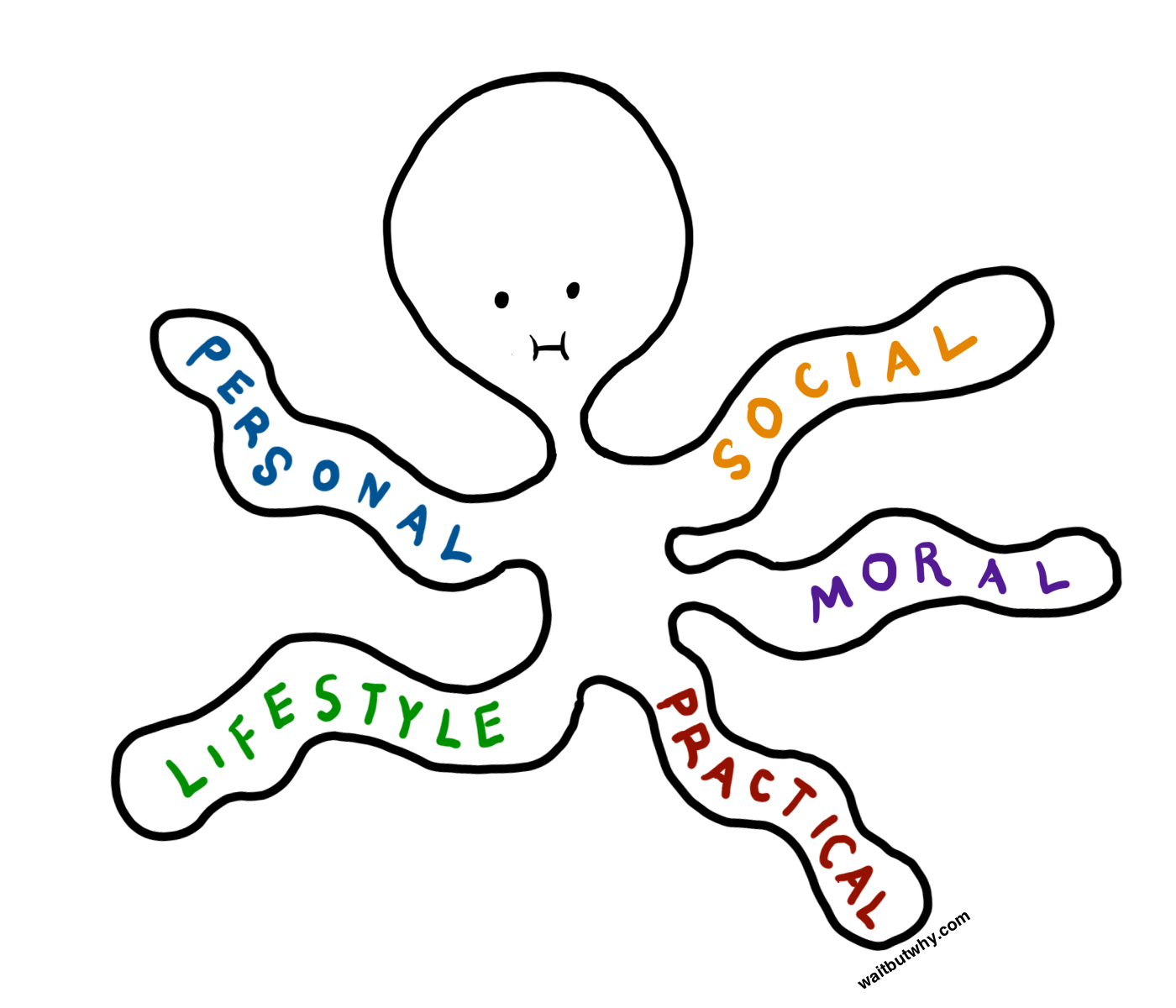
In Tim's post, he sets out a structured (and delightfully illustrated) framework for how to interrogate the career pathway. It begins with understanding your own yearnings and fears for your career. These become the tentacles on your yearning octopus, and represent what you want or need: things like personal fulfilment, moral values, and practical needs. Tim then asks you to take these down to the interrogation room in denial prison, and really deeply examine why you want these things - and whether those desires are yours, or those imposed by others externally. For each yearning, what is really happening there? If you passionately want to work as a meteorologist, is that because you have a genuine and specific curiosity around cloud formations, or is that you simply want to work on something which generates passion and curiosity more generally? If you want to do something good in the world, is that coming from you, or from a sense of guilt or expectation that comes from your parents or your upbringing? Who knows what you'll find down there. The rest of the steps examine the career landscape and opportunities; evaluate your potential, including your skills and resources, and then map out potential paths that align both with these true desires and realistic possibilities.
It's a remarkable framework in many ways, although it's this process of examining your deepest yearnings that has been most interesting for me overall. It's also perfect timing for it to have come back in my orbit. Over the last year, I've been on a career break to travel, which is the first time I've ever taken an extended break from work. I'm also at an interesting point in my career: I have a nice round 10 years of work experience, which puts me at solidly mid-career, with a decent range of expertise and a reputation as a capable urbanist-policy-strategy person. I have range of options for what I could do next, but no particularly fixed idea of what that should be. Enter stage left, the yearning octopus, to take me down to denial prison and see what's really going on there.
My journey to denial prison
What struck me first as I started mapping out the various needs, desires and fears of my yearning octopus was how difficult it is to separate out the desires that relate to my career from those of my life as a whole. I don't think this is particularly surprising: considering how much time and energy we have to put into our work, it has a lot of heavy lifting to do in terms of fulfilling your needs and enabling your overall quality of life. But it also became clear that I've relied on my career to fulfil a significant majority of my yearnings over the last ten years. To secure a sense of purpose and identity, a feeling of having impact, external recognition and validation, curiosity and passion, financial security, social connections, and a whole load of other things, from one job - is asking a lot. Is it really realistic for one job to provide? No wonder there have been frustrations and disappointments.
I don't think the answer is to artificially separate out which yearnings are "career" yearnings and which are "life" yearnings - they are one and the same. But being able to map these out gives you more agency to be able trade them off against each other, and potentially accept a job that might only give you some of these - so long as you can still create space in other parts of your life for those yearnings, or accept that there will be certain periods in life where some needs will be prioritised over others.
My other surprise down in denial prison was that I expected to find specific challenges and issues that I would want to focus on. My whole reason for ignoring Ben's advice at the end of university was that I wanted to work in urbanism, and I've put a significant amount of time and energy into the field since then, as well as crossing over into a whole range of interrelated policy issues, like climate change, economic prosperity, skills, community development, housing, and public health. On one level, I'm certainly interested in all of these things.
In reality though, none of these individual "issues" came up as particularly important to me. I don't seem to have one particular thing which I want to fix or focus on. Instead, it turns out that what really excites and motivates me is the process of understanding the interrelationships between all the different parts of a system, and being part of the sense-making and problem-solving that that system requires. Everything is interconnected, and you could probably drop me at any point in that system and I would be equally motivated and interested to figure out where I was and how it interrelates to everything else around it. That realisation has been incredibly freeing for me, because it gives space to be both curious and excited about all the individual parts of the system, without getting arbitrarily detained by one of them.
The other things I discovered in denial prison were things which I’ve noticed around for a little while, but which have been brought up to the surface and perhaps which I hadn't given full credence to before.
I value variety, and I want the option to work on a range of different projects and challenges (my worst nightmare would be working on one project for the rest of my career).
I love teaching and coaching, and I get a very particular sense of satisfaction and joy out of helping people learn and grow, especially at the point at which they go and do it without my help.
I don't want to be the most knowledgeable person in the room - I want to work directly with bright, critical people who I can learn from and share ideas with.
And I do actually want to make a difference through my work, although I don't have too many delusions of grandeur about fixing some of the world's big problems. Instead, I want to help systems work in a more fluid way by figuring out how they work, picking them apart and putting them back together again, and if that in turn can allow things to actually happen and decisions to be made, then we (should) see progress and change in the world. (And if not, you missed a bit.)
There’s some value in getting older
I suspect that if Tim Urban had already written his blog post when I was 21, and I had sat down and done this exercise, I still wouldn't have had the perspective to be able to see any of these underlying motivations. Having had a few more years of living and working and been able to observe all of the things that either excite me or piss me off, I've gained something concrete to reflect upon and some decent evidence about what I might want in the future. How bizarre, then, that we put so much pressure and emphasis on making these decisions young. It won't be for everyone, but perhaps there's something to be said for using your 20s to gain as much experience and as many skills as you can, rather than rushing into a particular direction out of fear or expectation.
There's various evidence to suggest that people achieve their greatest impact in middle age, not youth. So given at 34 I still have at least 30 years of my working life ahead of me (and almost certainly more considering the drifting retirement age), I'm not feeling particularly concerned about wandering and changing course. When I re-examine the state of my yearning octopus again in 10 years time, I suspect that he'll have grown some new tentacles (and maybe lost a few), which would be impressive for me, but all part of a day's work for an octopus, which is a regenerative organism after all.
If you think you might want to go through this process yourself, I made it easier for myself by turning the original blog post into a step-by-step guide (it’s almost exactly the same content, just in an easier to follow format). You can use it yourself here.
Really enjoyed the read, Elli, and thanks for sharing. I am 63 and have spent much of my life pondering on these issues. I can really relate to John Lennon's 'life is what happens when you are making other plans'.
We have around 10,000 days of life and much of what we experience is random, defined by birth and other factors we have little control over. What happens is we are 'shaken down' random pathways for reasons that are often no more than chance. However, we can influence what we do, but asking the right questions are important.
When I was growing up, I was often asked 'what do you want to do when you leave school'? This is the wrong question to ask anyone at any age. We have no idea of the options. Take it from me - 3 sorts of toothpaste in a supermarket send me into a panic!
A better question is 'who would you like to be?'. And then. 'what is it about this person you like'? People look for role models. They attribute values, lifestyle, personality to people. It doesn't matter whether their imagined persona is accurate. What matters is that it is rich and nuanced and alive. It gives a foundation for action toward happiness.
I like the Octopus. I also like Neil's Wheel, which I found helpful. https://neilswheel.org
I am not sure that a thoughtful human being will ever find the one thing we want to be. I wanted to do something worthwhile and this remains my touchstone for fulfillment. I have not spent my life in a role that meets this criteria, but I hope that I have gone on a jounrey that is beginning to produce some wisdom that will help me achieve this goal. In the jounrey I have been able to have three or four lives. I have learned to let go of past choices and now focus on how I can use all those random experience thoughtfully,to help me be the best person I can be right now. I will check back in with myself when I start my next life on the back of this experience.