
Why do we keep having the same meetings over and over again?
Part 1 of a series - the fogginess of complex projects, and why it's such a problem in local government

For much of my first year in local government, I felt like I was having a lot of the same conversations over and over again, while very little seemed to be progressing. It took some time of feeling like things were going in circles before I realised that this wasn't (necessarily) a failure. Rather, I was in the foggy and often unglamorous space before problems have been defined or tasks identified - or pre-stage 0, as I'll call it here. In this post, which is the first of a series of (probably) 2, I’ll talk mostly about what I think this foggy pre-stage 0 space is, and why I think it’s relevant and interesting to us, as well as uncomfortable and confusing, particularly within a local government context. In the second part, I’ll talk about how we can navigate it, based on my own experiences of trying to walk around in the fog, and some reflections on how we could do this more effectively and comfortably together in the future.
Many of the ideas and reflections here will likely feel very familiar, particularly to designers and facilitators used to working in these type of ambiguous, complex or early-stage environments; and the context and the challenge of how this works within local government will, I imagine, resonate with colleagues across town halls and beyond. I don’t presume my observations to be original, but I have been surprised at the extent to which this ambiguous phase feels both very significant within local government, as a critical place for ensuring that we are solving the right challenges and diverting limited resources effectively; but also almost completely invisible, with little awareness within standard government practice and few tools or approaches with which to navigate it.
If this observation is true (although I’m both willing and curious to be challenged on it), then this seems to be a space worth investigating further - how can we build better awareness of this pre-stage 0 space within projects, teams and organisations? How can we formalise this into the way that we develop projects, processes and policies? And what new structures, tools or mindsets do we need to help build it into the day-to-day practice of civil servants and local government officers? If these questions and/or any of my observations resonate with you, or if you already have some good answers, I’d be very happy to explore it further.
Some personal background, and the nature of foggy projects
I joined the London Borough of Newham in 2021 as an Associate with Public Practice, who are a UK-based not for profit organisation working to build the design and placemaking capacity of the public sector. Up until that point my career had been spent working primarily on behalf of local government and adjacent public bodies - both as a researcher in a think tank, and a strategic design advisor for infrastructure, regeneration and placemaking projects and organisations - but this marked my first foray directly into public service. The Public Practice programme includes one day a fortnight dedicated to learning and development (or group therapy, as I called it), which no doubt helped me maintain my sanity during this time, but also afforded me the time to reflect on what was happening in my day job, and to see some of the wood for the trees. If it weren’t for this, I might still be walking around in the fog, banging into things, so a moment of thanks for the excellent people at Public Practice for this.
The role I was placed into involved leading the Council’s response to two large strategic regeneration partnerships. They were both very early-stage initiatives, which were focussed more on political alignment, organisational structure and policy frameworks than on delivery; they both spanned multiple directorates within the Council, requiring a joined-up approach; and they were both partnerships with a large number of external bodies, meaning that most of the decision-making sat either outside the Council, or only partly with it. I think this makes them a particularly good training ground for this pre-stage 0 space: there was a lot of activity going on, but it was highly distributed across different organisations, teams and projects. There was often limited visibility on what that activity was, made more complex by the political and commercial sensitivity of the projects. And there were a lot of different people involved, many of whom had various opinions on the challenges and the objectives, some of which quite highly-charged, and many of which didn’t align. In other words, we didn’t really know what we were trying to do, and we didn’t really know how we were going to do it. In the words of Eddie Obeng, we were firmly in the fog.
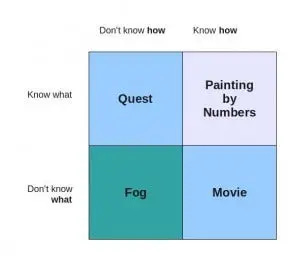
For one of these projects, I vividly remember reading the documents I'd been sent in my first week, writing a list of around 40 questions to ask my team, and receiving the response: "These are excellent questions. We don't know the answers, so those are things for you to find out." (The mistake, of course, is assuming that there is yet an answer.) For the other, I remember receiving a phone call from our then-Corporate Director, who asked me if I could provide some additional assistance alongside my main work; not that there was any specific action which needed taking, he said, but more that it would help if I could just... figure out what was going on?
What followed was a year of intense immersion into the weird and woolly world of how we navigate this somewhat uncomfortable pre-stage 0 fog and try to get out of it together, safely. And every situation will look somewhat different, but I suspect many people in local government and beyond will recognise this feeling too, and to those who may have felt similarly at sea, I offer the assurance that if I could get out of it, then I imagine that you can too.
What is a project before it's a project?
Within architecture and urban design, we use the RIBA Stages to navigate our way through projects, which run from Stage 0 (Strategic Definition) to Stage 7 (In Use). They provide a helpful map to walk through everything that needs to be done at each stage; most sectors and disciplines have their own version (like Agile or Prince2) and they are all broadly similar in the key ways.
The problem with any project lifecycle is that it has to have a beginning and an end. Understandable: this is where the vast majority of the activity, decision-making and investment happens, and the stages through design, planning and construction require significant coordination and technical expertise.
But what happens before then, and how do you get to the beginning - to the point of identifying a need, or writing a brief? For an individual or small project this process is (relatively) straightforward: I could notice that I need somewhere to store my garden tools, measure up my garden, go out and buy a shed and build it myself.
But the more people involved, and the more complex the system, the harder this process is. Many projects, and particularly those in complex systems that require collective coordination and decision-making - like within government, or cities, or large-scale organisations - don't emerge from a single individual. Instead, there is a long period of loose thinking that gradually builds towards the collective understanding and the visibility required to get to the point of "Strategic Definition" - what are we trying to do, and how do we do it.
Most of my work in urbanism has fallen in this murky space, which tends to be occupied more by politicians, investors, policymakers and communities rather than technicians. This pre-Stage 0 space is where individuals or organisations are figuring out or articulating needs or objectives: do we need new housing, new infrastructure or better skills programmes? What sorts of things might achieve that - is it investment, regulation or advocacy? Is there an opportunity we could capture, or a need we haven't fulfilled? This is a huge co-ordination challenge, and while we have various kinds of infrastructure to help us scaffold this space - this is the role of legislation, policy and governance - those artefacts don't emerge from nowhere. This pre-stage 0 phase is defined more by an absence of things than a presence, is inherently invisible, and therefore rarely talked about - but also critically important.
The reason to linger in the pre-stage 0 fog
As foggy as it is, the pre-stage 0 space is also perhaps one of the most important places where we can have impact - this is the place from which we decide where to invest our resource or energy, and from which ideas, policies, business cases or projects ultimately emerge. Fail to notice it, and you fail to notice the potential opportunities that you might miss, the possible risks that you might not notice, or the underlying connectivity between the things that you do end up doing.
We know that some of the deepest challenges that local authorities are trying to influence - addressing climate change; improving health; overcoming poverty and expanding opportunities, and supporting social cohesion - are all deeply interlinked. Address one and you influence the other; you can’t tackle child obesity without thinking about how a family earns enough money each week to buy healthy food. Anyone in front line services knows this, but the challenge is how to actually be able to take a step back from implementation, to make sense of the complexity of the situation, and to appreciate that a space exists before stage 0 from which you are able to make different choices or work in different ways. This takes strategic awareness, cognitive load and time, most of which are things that are in short supply within resource-constrained local governments. The irony, of course, is that not lingering in this space often means that huge wasted effort goes into individual services or projects that are inefficient, solving the wrong problem, duplicating someone else’s work, or simply could be done better in a different way.
Building this collective understanding of the complex system in which we are all operating relies on drawing a clear (enough) picture, which is shared across the organisation, of their context, what the challenges and the opportunities are, of the work that they are already doing, and of their collective aims and objectives. In other words, it relies on a map - something which shows each individual person or team where they are, what they are doing, and from which they can navigate themselves - rather than forcing them to walk around and deliver critical services while effectively blindfolded.
This idea of a civic map isn’t new. When the “smart cities” agenda was first appearing, there were many promises and interesting case studies exploring the potential of “city dashboards” - a single reference point that could capture data from across the city, as well as performance metrics, acting as a powerful tool for internal coordination. And these initiatives have undoubtedly improved city performance - the Rio de Janeiro Centro de Operações is perhaps the best known example, which has enabled faster responses and more effective integration of services. But the promise hasn’t really borne out in reality. Early criticisms of the problems of these dashboards in simplifying the complexity of urban environments down to a few quantifiable metrics have never really been deeply addressed. And now there’s more of a growing recognition that building a really effective civic decision-making infrastructure will rely on far more than a dashboard: technology cannot simply replace or overlay the more fundamental changes we need to our governance, infrastructure and bureaucracy in order to help both people and machines interact more effectively together, both within and beyond the town hall, and build the understanding required to make better decisions together.1
These are questions that are being addressed actively within a number of different domains. In particular, the work of Geoff Mulgan and others on collective intelligence seems particularly pertinent here, and his book Big Minds, albeit a few years old now, is a hugely thought-provoking read on how it is that we make sense of things both as individuals and collectively, and what mechanisms need to be in place to facilitate this. I think there are also some highly valuable insights to be drawn from other domains such as computational social science and the interface between humans and machines - and particularly the question around the future role of AI - that can help us understand both how we can build this collective understanding of the systems we are within, and then how we can apply it in practice as decision-makers, policymakers and practitioners. These are explorations for another day, but would no doubt help us draw a better map, which we can all read and update together, in order to navigate with.
Is this a space, or is it a stage?
At risk of sounding esoteric, I wondered for a bit about whether this is a “pre-stage 0 stage” or a “pre-stage 0 space”. Does it exist as a moment in time, or is it a space that we inhabit? I think it’s the latter. We’re quite pre-disposed, particularly in Western cultures, to think of things in terms of time: we organise our thinking more around progress, development and planning, than we do around the way that each of the spaces that we inhabit function or feel. We are concerned more about what’s next, than about what’s around us. (This is even baked into our language and grammatical structures). That’s good in many ways - it helps us progress, develop, move forwards. In other ways, it’s bad. We’re not so conscious of simply being aware of what’s around us now - what’s the setting we’re working within? Who is involved and who is affected? And how does this connect to the broader environment?
I think conceptualising this as more as a “space” can therefore help us - more to give us permission to simply ask, “where are we now?" rather than being hung up on, “where are we going next?” And that’s the whole point of fog anyway - good luck making progress out of that fast.
The psychological challenge of inhabiting uncertainty
I think another part of the reason that this foggy space is so rarely spoken about and also why it is so difficult for people to operate in is that it is intrinsically abstract and undefined. Humans on the whole are not predisposed to be comfortable with uncertainty; there's various evidence that suggests uncertainty is a key contributor to anxiety,2 and our minds are expert-pattern creators, so we will much prefer to jump to a conclusion or speed ahead to a solution rather than spend time in this uncomfortable space. That's understandable, but a bit of a problem, especially when the challenges we're working on are so complex, interlinked and don't necessarily have an easy solution. It's particularly a problem when we are tempted to revert to previous solutions as an answer, regardless of whether they've worked or not, and helps to explain why it is that I've sat in so many meetings where people ask "how have other local councils done this?" or "are there any case studies that we can follow?” I'm not saying that case studies or sharing best practice isn't helpful - on the contrary, this can often give something around which to structure our thinking - but the temptation to jump forwards to action too soon misses out a critical step in our collective thinking. Nonetheless, awareness of the fundamental discomfort of this process is probably helpful for navigating it, and can encourage us to give ourselves a little more support as we walk out into the fog.
So where do we go now?
If I’m right about this pre-stage 0 space, then we have a bit of a problem: one of the most critical phases of any complex project or policy initiative is also the one that is arguably most difficult to handle. We’re walking around in a space where we can’t see anything, we’re anxious and lost, and worst of all, much of the time we don’t even realise that we’re in it. But it’s also exactly the place where we determine what it is that we want to do, how we want to do it, and what resources we will put into making it happen, and it’s critically important that we do that with others at the same time - so that we don’t all end up walking in different directions.
I think this alone probably justifies some further thought and attention, to help build at the very least our awareness of the fog that we find ourselves in. And also the good news is that it’s not like we’ve never navigated this before. There are plenty of quite well-established methods for helping us navigate the fog; here enter the facilitators, the designers, and the systems thinkers, who within a diverse set of sectors and professions have been doing this stuff for ages. Phew. Thank God.
In Part 2, I’ll share a bit more about how I ended up doing this: the tools and approaches that I used to try to make sense of the situations I was working in, and how they helped to turn circular conversations into more productive discussions. I’ll talk about the critical role of artefacts like maps, diagrams and charts in building our collective understanding, how they can help individuals and organisations build trust in each other, and what we might need to do to apply these approaches more systematically across local government.
Sadowski, J. (2021). ‘Anyway, the dashboard is dead’: On trying to build urban informatics. New Media & Society, 26(1), 313-328. https://doi.org/10.1177/14614448211058455
Wever M, Smeets P, Sternheim L. Neural Correlates of Intolerance of Uncertainty in Clinical Disorders. J Neuropsychiatry Clin Neurosci. 2015 Fall;27(4):345-53. doi: 10.1176/appi.neuropsych.14120387. https://pubmed.ncbi.nlm.nih.gov/26185902/
Very much in this space now. Being flippant; the analogy I that occurred while reading this was the first time I played Mario-kart on the N-64, being dropped into Rainbow Road while incredibly ‘heightened’… no idea what the buttons do, the road is unpredictable, nothing really makes sense, but we must forge on as our peers insist upon it 🌈. As you’ve alluded to here this, two defining factors is we are never starting from a blank slate and a lot of the work is understanding from multiple perspectives where we are NOW. And the demand for ACTION, KPI’s must be defined and met and reports must show progressssssss